From Strategy to Stack: Building an AI-Native Blueprint · The Pritam Edge
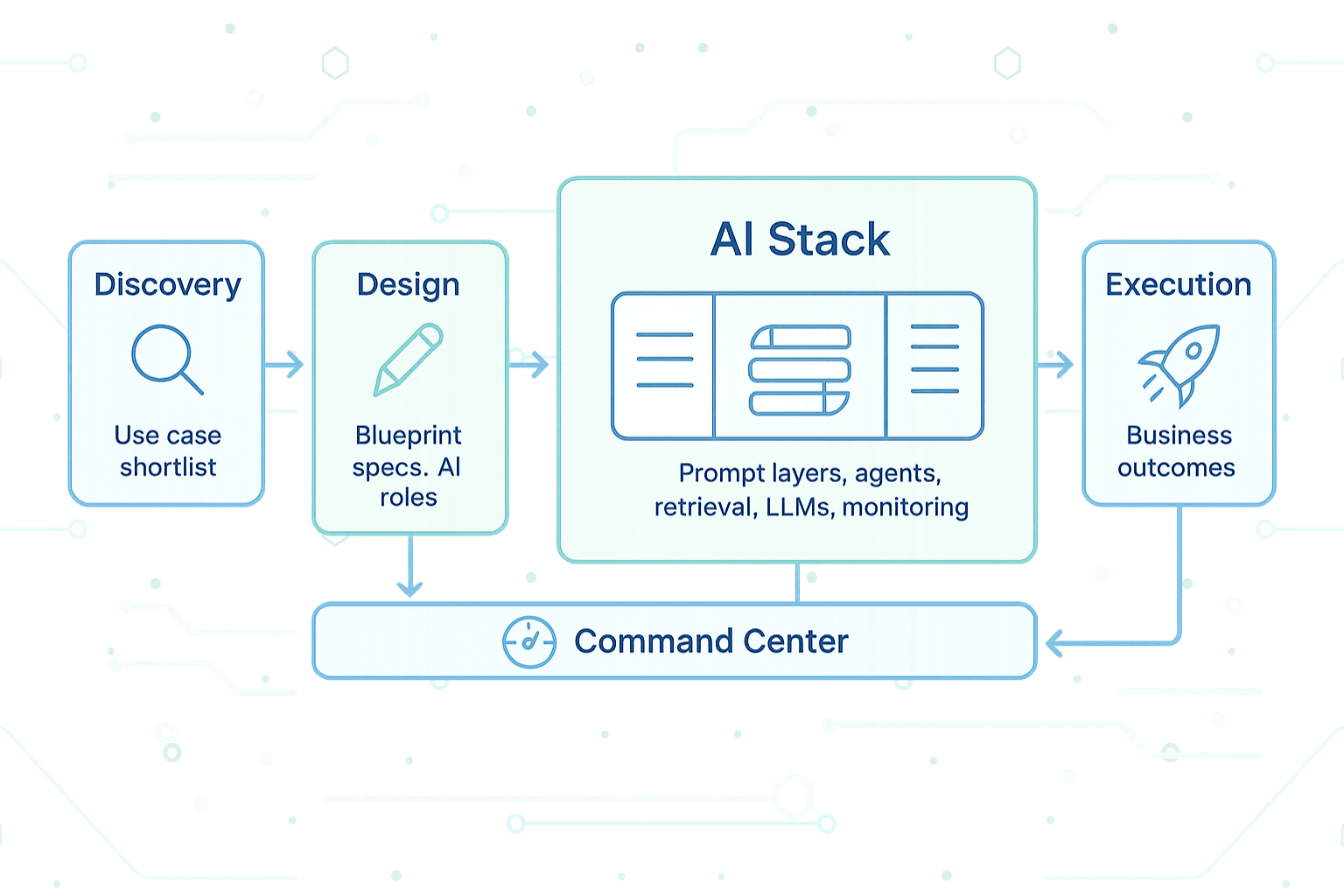
AI doesn’t transform your business until it transforms your systems. Here’s how to go from a GenAI strategy deck to a live, modular, scalable execution stack. Turn discovery insights and design deliverables into a modular, scalable, AI-native tech stack.
Where This Fits in the AI Journey
This is Post 4 of the AI Blueprint Series - your execution blueprint:
- Discovery Done Right →
- Design Thinking for AI-Native Systems →
- AI ProcessOps: The New Org Layer →
- You are here → From Strategy to Stack
AI Tools ≠ AI Systems
Most companies have “played” with AI.
But few have made it operational - measurable, governable, and repeatable.
The difference? A modular AI-native stack that connects business triggers, GenAI models, and humans-in-the-loop - at scale.
If you’re a CEO, Founder or a Business Leader, this is your operating model for the next decade.
What Makes a Stack "AI-Native"?
A true AI-native stack does more than run models. It:
- Makes decisions with context and memory
- Adapts in real-time to human feedback
- Integrates deeply with processes, not just chat windows
- Enables governance at the speed of creativity
Key Architectural Traits
| Trait | Description |
|---|---|
| AI-Based UX | Assistive design with fallback, previews, and guidance |
| MCP (Model Context Protocol) | Business-ready injection of context, data, and guardrails |
| Agentic Layer | Task routing, stateful chaining, autonomy for GenAI flows |
| RAG Retrieval Layer | Ingest and query internal knowledge seamlessly |
| HITL-Aware Logic | Escalations, approvals, and trust checkpoints |
| Command Center | Your centralized AI operations control tower |
| Policy Engine | Aligns AI behavior with legal, risk, and ethics frameworks |
Mapping Strategy to Stack
You don’t start with tech. You start with truth:
- What matters to your business?
- Where is your process bottlenecked?
- Where are humans repeating work?
That’s what your AI Blueprint (Discovery + Design + ProcessOps) reveals.
Your stack implements it.
But not just any stack. It must be:
- Context-Aware - because models are only as smart as the context you feed them
- Prompt-Orchestrated - because workflows need structured, reusable prompts
- Agentic - because automation now thinks, not just executes
- HITL-Governed - because trust comes from oversight, not just accuracy
- Policy-Aware - because compliance, risk, and tone can’t be left to chance
- Measured - because every AI interaction is a metric
- Command-Controlled - because someone has to be in the driver’s seat
This is the difference between building AI projects and running an AI-native company.
Tool & Integration Strategy
| Phase | Stack Input | Tools & Considerations |
|---|---|---|
| Discovery | Use case heatmap, fitment scoring | Align tools to ROI potential |
| Design | Prompts, context maps, HITL steps | Modular prompt engines, RAG, UI |
| ProcessOps | Agent logic, escalation paths, feedback | Orchestration, logging, evaluation |
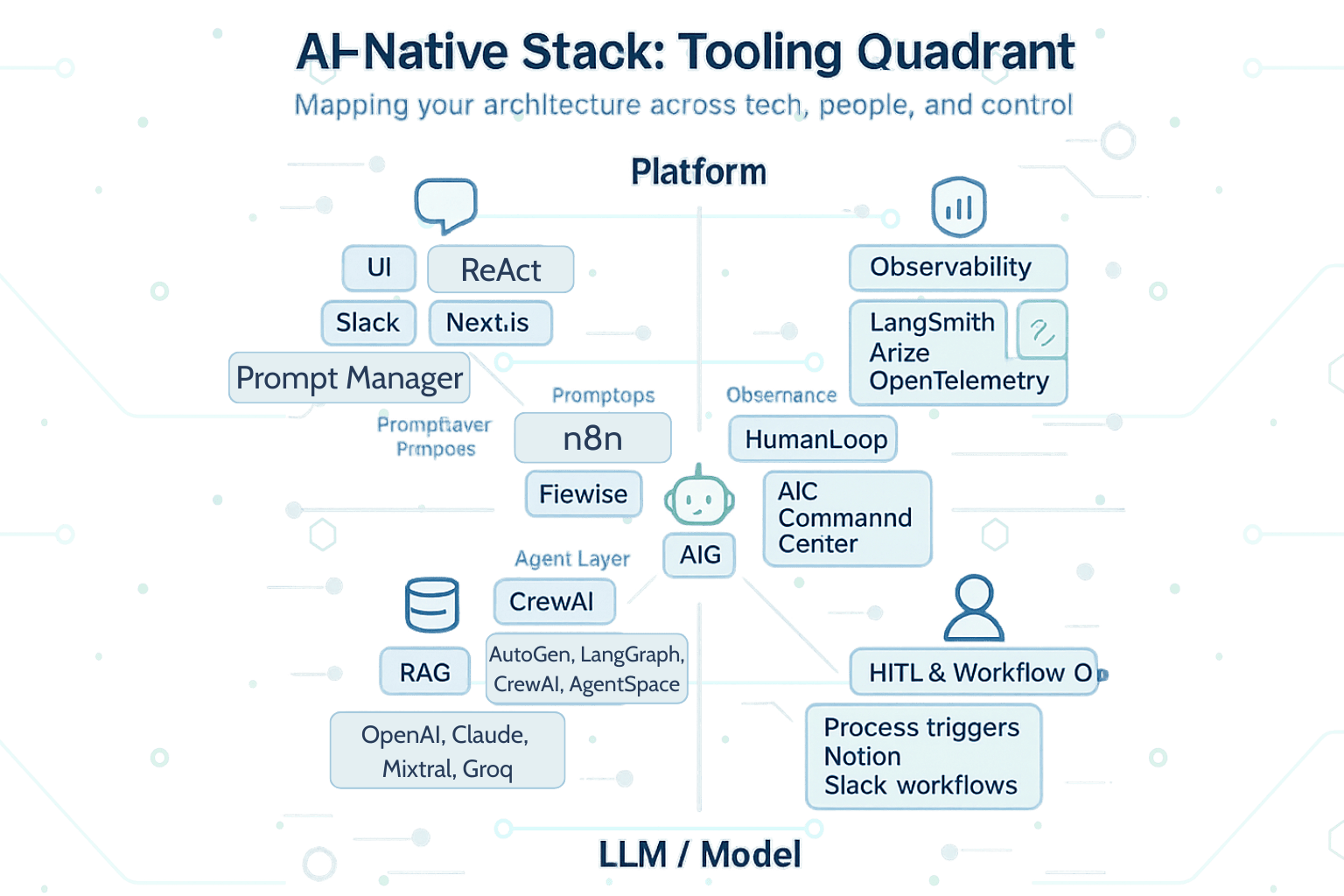
Tool Examples by Layer
| Layer | Sample Tools |
|---|---|
| UI | Retool, Slack, Next.js, n8n |
| PromptOps | PromptLayer, LMQL, Flowise |
| Agents | CrewAI, Autogen, LangGraph |
| RAG | LlamaIndex, Pinecone, Weaviate |
| Observability | LangSmith, Arize, OpenTelemetry |
| Governance | HumanLoop, Command Center* |
Core Layers of the AI-Native Stack
| Layer | Purpose + Goal |
|---|---|
| AI UX Layer | Seamless, assistive, embedded experiences |
| PromptOps Layer | Modular prompt chaining, context injection |
| Agentic Layer | Automated logic, fallback, tool execution |
| Retrieval Layer (RAG) | Live knowledge access for accuracy |
| Model Layer | Choice of LLMs, fine-tunes, or hosted APIs |
| Observability | Track prompt success, overrides, drifts |
| Governance & Command Center | Manage redlines, feedback, escalation flows, and policy enforcement |
This is not a stack diagram. It’s an operating system for your future business.
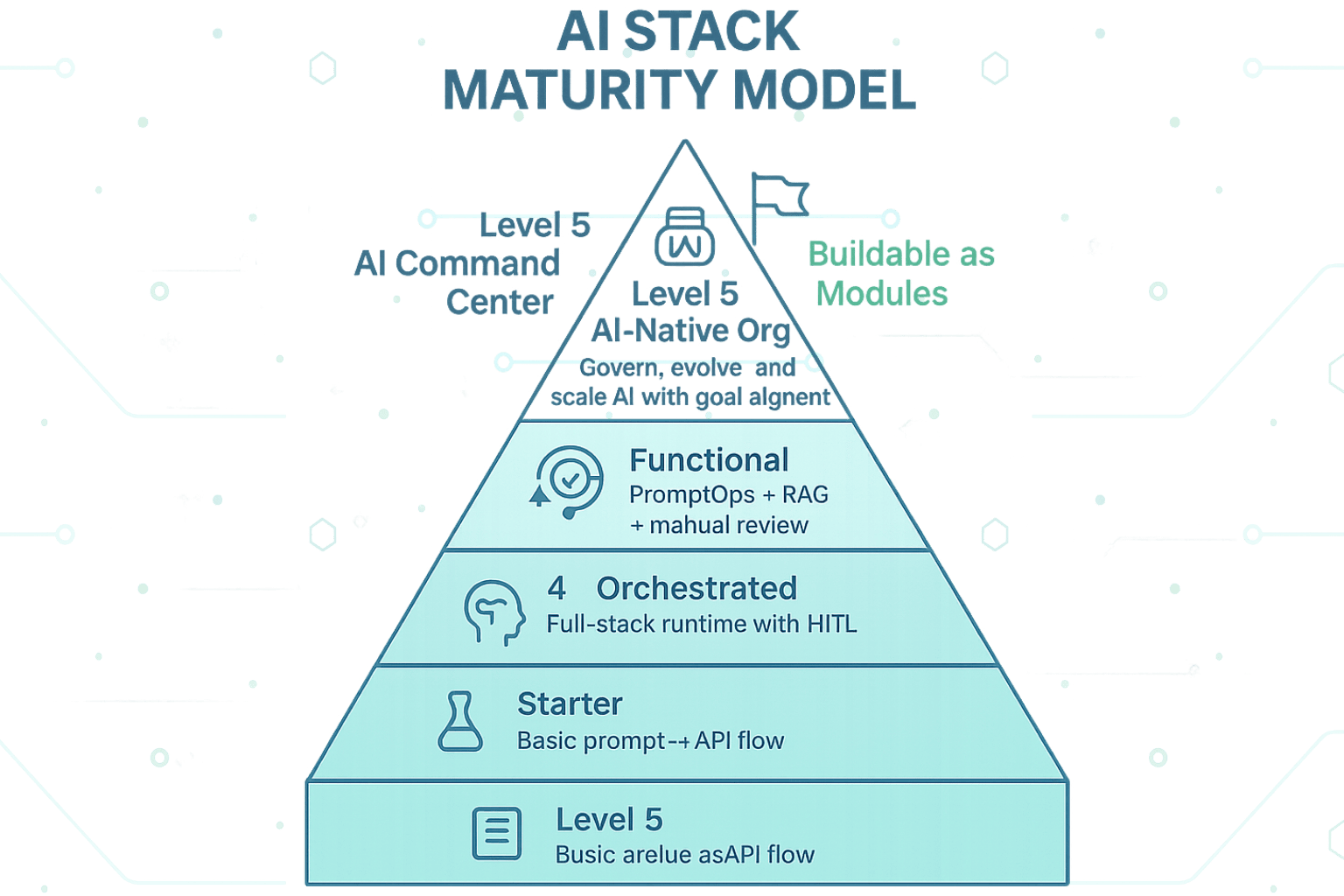
Stack by Maturity Level (Modular CMMI)
| Maturity Level | Description | Build It Modularly? |
|---|---|---|
| Level 1: Starter | Basic prompt → API flow | |
| Level 2: Functional | PromptOps + RAG + manual review | |
| Level 3: Orchestrated | Agents + ProcessOps + metrics | |
| Level 4: AI-Native Org | Full-stack runtime with HITL | |
| Level 5: AI Command Center | Govern, evolve, and scale AI with goal alignment |
Each layer can be bought, built, or plugged as a standalone product.
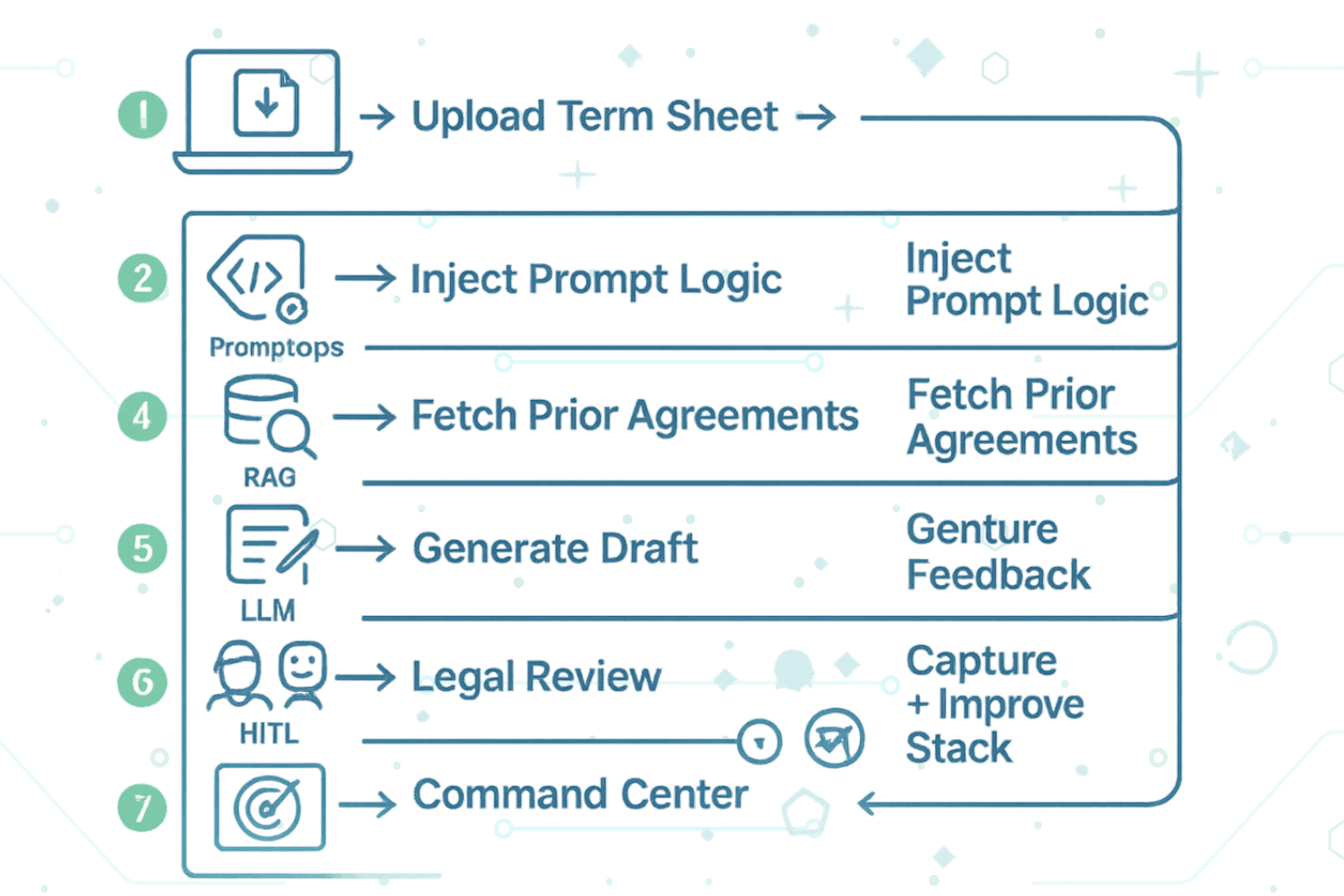
Use Case: Contract Draft Assistant
| AI-Native Layer | Execution in Use Case: Term Sheet to Contract |
|---|---|
| UI Layer | Upload term sheet via self-serve portal or integration (e.g., Slack, Notion) |
| PromptOps | Inject contract generation prompt with metadata (e.g., region, type, risk score) |
| Agent Layer | Trigger “Contract Drafter Agent” with tool access for clause builder + fallback policy |
| Retrieval (RAG) | Fetch prior agreements with similar party, use embedding similarity for clause selection |
| LLM Layer | Generate draft with contextual prompts + structure aligned to legal playbook |
| HITL Review | Legal team receives versioned output with inline “AI-generated” tags and redline suggestions |
| Command Center | Capture override frequency, clause reuse score, and prompt improvement metrics for optimization loop |
Governance: The AI Command Center
This is the single pane of glass for every stakeholder:
| Function | Outcome |
|---|---|
| Configure agents | Define rules + fallback |
| Monitor override metrics | See where AI fails or needs help |
| Apply redlines & policies | Enforce legal/brand constraints |
| Align goals | Track automation coverage, HITL % |
A Command Center isn’t a dashboard. It’s a real-time control system for AI workflows.
Metrics to Track
| Metric | What It Tells You |
|---|---|
| Prompt success | Model accuracy + tone alignment |
| HITL override % | Trust and precision metrics |
| Automation % | ROI measure |
| Latency | User experience quality |
| Drift index | Risk and performance guardrail |
Final Thought: AI Strategy Ends in Architecture
The blueprint is done.
Now it’s time to build.
If you’re a CEO, this stack is your:
- AI operating system
- Transformation playbook
- Workflow optimizer
- Governance guardrail
Build Your Stack, or Already in Motion, then run a Stack Maturity Diagnostic ?
Part of the AI Blueprint Series: From Discovery to Deployment