Expertise is dead! Long live experience! · The Pritam Edge
AI is codifying and automating our expertise. What stays irreplaceably human is experience: judgment, outcomes, and knowing why.
Vici, an established product manager, starts the day checking progress. Instead of manually gathering reports, Vici asks an AI agent: "What needs attention?"
The agent scans emails, checks design history and comments, checks feedback, identifies slippages and bottlenecks, generates action points, and drafts an email to the stakeholders, all in minutes. Vici is relieved that she just saved a few hours, but an uncomfortable feeling lingers: what if my manager directly asks the AI agent?
The real issue is that Vici's manager is asking the same question: why do they need me to ask the same question to 10 people? Can they not directly ask the AI?
This discomfort is the new normal in a world where AI automates our tasks, our daily schedules, our priorities, and our conversations. Gen AI has moved on from being text messages in a chat window, whose cute good mornings are now replaced with quick, efficient, cold analysis. Our expertise, today, stands codified, automated, possibly improved, and challenged.
But where does that leave us?
I weigh in with my knowledge and opinion across three threads:
- The gradual rise of Gen AI, and how it was inevitable
- The advent of agentic Gen AI
- The need for a shift in professional value
1. The gradual rise of agentic AI
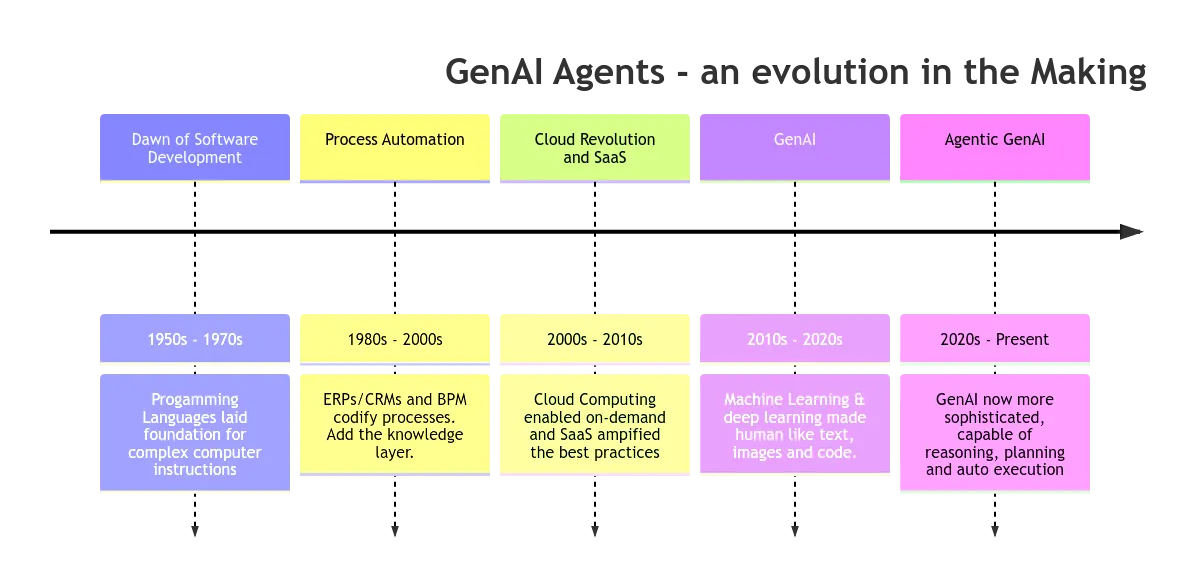
The transformative power of GenAI, though seemingly sudden, has been building for years. It is not a radical departure but the culmination of a gradual shift toward greater automation and reliance on technology to manage complex tasks. To understand its true impact, it helps to look back at the incremental steps that led here.
1950s to 1970s, the dawn of software development. Early programming languages and the first computer programs laid the foundation for the systematic creation of complex instructions computers could execute, setting the stage for automation.
1980s to 2000s, process automation. Businesses adopted software to automate specific tasks. Relational databases enabled efficient data storage and retrieval. ERP and CRM systems emerged, allowing greater control and visibility over operations. Efficiency became the focus, laying the groundwork for AI.
2000s to 2010s, cloud and SaaS. Cloud computing offered on-demand access to compute and applications, paving the way for Software as a Service, where businesses could buy software, infrastructure, and processes at a fraction of the price. Scalability and accessibility accelerated the shift toward data-driven decision-making. By Gartner's count, SaaS revenue reached $195 billion in 2023, a massive move toward tools over manual expertise.
2010s to 2020s, GenAI emergence. Advances in machine learning, particularly deep learning, produced models capable of understanding and generating human-like text, images, and code. Early applications focused on natural language processing, image recognition, and content creation.
2020s to present, agentic GenAI takes center stage. Models grew sophisticated enough to reason, plan, and execute complex tasks autonomously. The focus shifted from generating outputs to creating agents that interact with the environment, make decisions, and adapt. While expertise in skills and tools may be replaced by AI, this is not the end. Experience, outcomes, and human creativity become the new differentiators.
2. GenAI agents: beyond bots, toward autonomy
Tools are useless without the hands to wield them and the mind to guide them. That adage captures the leap from traditional bots to GenAI agents, a step where machines do not just assist, they act.
GenAI agents are not bots with upgrades. They are autonomous systems designed to solve real-world problems with a sophistication that goes beyond scripted responses. Equipped with tools, intelligence, and a mission-first mindset, they change how we work.
Imagine a colleague who never sleeps, learns on the job, and handles the tools they are given with precision. That is the promise. These agents leverage large language models not just to understand language but to use it as a medium for action. They can:
- Understand context and instructions, like an assistant who gets you.
- Reason about plans and actions, forming strategies, not just tasks.
- Execute actions, from sending emails to analyzing datasets.
Agentic AI is built for complexity
AI agent architectures are the frameworks that define how agents perceive, process, and act to achieve goals. Their key components:
- Perception and sensing: interpreting raw data (images, text, sensor readings), often with computer vision or NLP. Examples: OpenAI's Assistants API for multimodal input, and browser-context agents.
- Reasoning and decision-making: ReAct combines reasoning with immediate action; MRKL decomposes tasks across specialized modules.
- Planning and learning: BabyAGI mimics goal-setting and iterative refinement; AgentGPT automates through recursive goal execution.
- Action and execution: GPTs provide versatile action across domains; API-driven agents handle domain-specific execution.
- Feedback loops: chain-of-abstraction frameworks enable hierarchical reasoning; LLM compilers optimize feedback-driven execution.
Architectures, matched to the job
- Reactive focus on immediate responses without long-term planning. Good for quick, rule-based decisions: real-time customer resolutions, non-critical triage.
- Deliberative emphasize long-term planning and structured reasoning: financial analysis and forecasting, complex diagnostics.
- Hybrid blend the two, balancing quick action with strategy: debugging and test generation, campaign optimization.
- Layered organize perception, reasoning, and action into modular layers for multi-faceted tasks: personalized tutoring, ad and brand management.
How agents differ from bots
Traditional bots follow strict instructions. Agents anticipate needs, adapt, and take ownership.
- Bots run on fixed scripts, struggle with nuance, and complete basic tasks (booking tickets, answering FAQs).
- Agents operate with autonomy, adjust strategy from real-time feedback, and take real-world action (sending emails, updating systems, producing reports).
As one tech leader put it, bots are the paintbrushes; agents are the artists.
The road ahead
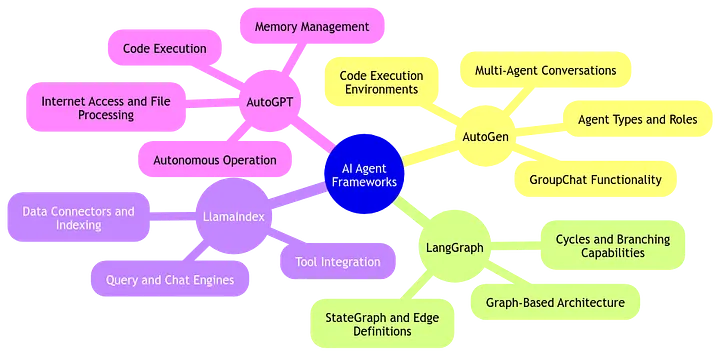
Alan Turing asked whether machines can think. That is no longer up for debate: machines reason, act, and transform the world around them. Frameworks like AutoGen, LangChain, and LlamaIndex let developers build and deploy these agents, each iteration pushing the boundary. The generative AI market, valued at $40 billion in 2023, is expected to grow at a 35 percent CAGR, a signal of how embedded this will become.
3. The shift in professional value
As agents evolve, they will redefine how we interact with technology. We are not just building tools anymore. We are building collaborators, not competitors, at least not yet.
Focus on outcomes. Success will no longer be defined by knowing how to do something, but by having the experience to guide outcomes. Delivering business outcomes gets easier when the grunt work is handled. Menial, repetitive tasks move to agents, freeing people for richer, outcome-oriented work that needs judgment, empathy, and innovation.
Skills like software development, process management, and customer success are increasingly automated. Companies use AI for data analytics while their teams interpret and act on the insights. Some examples of the industry adapting:
- A process manager who once tracked milestones by hand now delegates it to an AI assistant.
- Databricks Workflows automates data processing and ML pipelines, letting data teams focus on interpretation and strategy.
- OpenAI's work with BBVA integrated ChatGPT Enterprise to automate routine tasks, shifting employees toward complex problem-solving and customer engagement.
The McDonald's case. When self-service kiosks arrived, critics predicted mass job losses. Instead, kiosks reshaped work, freeing employees for guest assistance and kitchen roles while increasing sales through automated upselling. They created a restaurant within a restaurant, needing more staff for mobile orders, delivery, and experience. Like ATMs before them, kiosks shifted tasks rather than eliminating workers.
Long live experience
The era of expertise as mere skill mastery is over. The future belongs to those who build on their experience: navigating complexity, solving unstructured problems, and delivering results beyond what AI can achieve. Employers now value the wisdom gained from challenges faced and outcomes delivered.
A marketer's creativity is the example: AI can suggest campaign ideas, but only an experienced marketer knows which strategy resonates, and why. Expertise teaches how. Experience teaches why. In a world of AI, understanding the why makes all the difference.
So professionals must pivot from listing the tools they know to showing the value they bring: experience overcoming challenges, the ability to turn insight into decisions, and the human touch of creativity and judgment that AI cannot replicate.
Expertise is dead. Long live experience. In the age of AI, your value lies in what makes you irreplaceably human: the ability to create, connect, and deliver outcomes no bot ever could.
The baton has been passed. It is no longer about knowing how to do it. It is about knowing how to make it matter.