Building Industry-Ready AI Models, A Product Manager’s Guide to AI Governance · The Pritam Edge
Product Managers are no longer just optimizing model performance - we are accountable for model integrity. We explore how to build governance as a first-class product features. From fairness audits to DLP-based redaction and drift monitoring operationalize responsible AI principl
Why Governance Is Product-Critical
Building AI that works is not enough. Today, we need to build AI that behaves - responsibly, reliably, and transparently. For Product Managers driving AI initiatives, governance is no longer a regulatory afterthought - it’s a core product function. It’s what allows AI to move from prototype to production in industries like finance, healthcare, manufacturing, and government.
When models interact with real people, carry real risk, or generate real decisions, governance becomes the product’s conscience.
What Governance Really Means in AI Products
Governance in the context of AI models means:
- Traceability: Can you explain where a model came from, who trained it, and on what data?
- Auditability: Can external reviewers validate how your model behaves in real use?
- Accountability: Do you have human-in-the-loop checkpoints, fallback plans, and monitoring?
- Safety: Are there guardrails for hallucinations, toxicity, or data leaks?
- Compliance: Can your model stand up to legal and ethical scrutiny?
For PMs, these aren’t tech checkboxes - they’re risk controls that protect trust and accelerate scale.
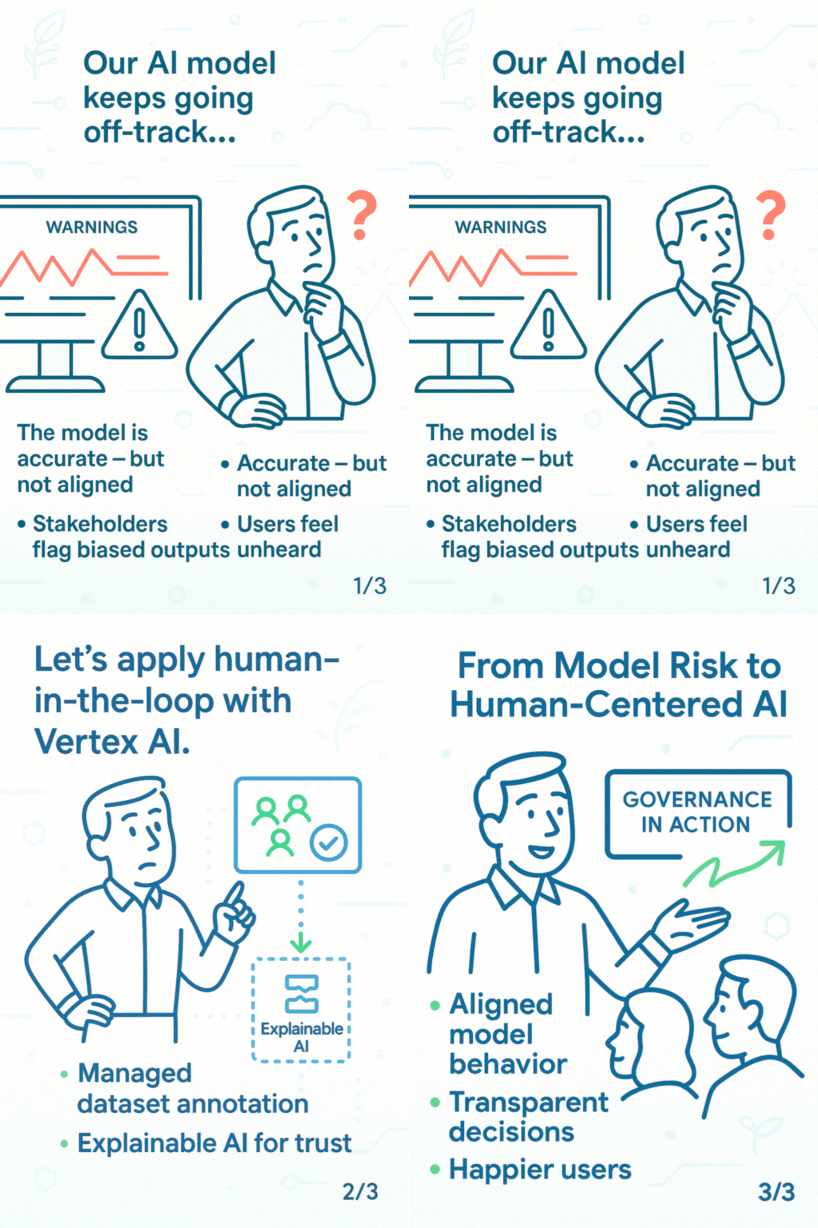
Responsible AI = Human-Centered Design at Scale
In Google’s Responsible AI Framework, the pillars of model behavior extend beyond just accuracy or latency:
- Helpfulness, Does the model actually solve user intent?
- Honesty, Can it admit uncertainty or avoid hallucinating?
- Fairness, Does it treat all groups equitably?
- Safety, Does it avoid harmful or toxic output?
- Transparency, Can users understand why it behaved a certain way?
Governance means making these traits measurable, enforceable, and visible at every phase of the model lifecycle.
Governance with Vertex AI: Tools, Bias Mitigation & Interpretability
Google Cloud’s Vertex AI provides robust capabilities to support a full-spectrum governance strategy:
| Capability | Vertex AI Tool |
|---|---|
| Metadata Tracking | MLMD (Metadata Store), Vertex Pipelines |
| Explainability | SHAP, XRAI, Model Cards, Explainable AI APIs |
| Auditability | Model Registry, Artifact lineage, Experiment tracking |
| Safety Monitoring | Vertex Model Monitoring (data + prediction drift) |
| Fairness Auditing | TFX + What-If Tool (TFRecords, slices) |
| Sensitive Data Protection | DLP API + Workbench integration with Gemini output |
These tools aren’t just for ML engineers - they’re core to how PMs validate product readiness.
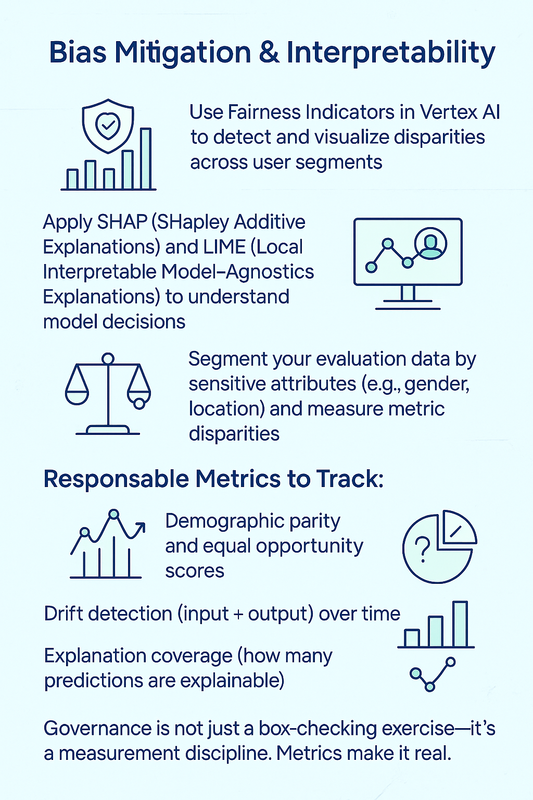
Responsible Metrics to Track:
- Demographic parity and equal opportunity scores
- Drift detection (input + output) over time
- Explanation coverage (how many predictions are explainable?)
- False positive/negative ratio per segment
Governance is not just a box-checking exercise, it’s a measurement discipline. Metrics make it real.
Governance is not just a box-checking exercise - it’s a measurement discipline. Metrics make it real.
Redacting Sensitive Content from GenAI Responses
Vertex AI now integrates with Cloud DLP API to help Product Managers proactively mitigate risks related to sensitive data.
You can:
- Generate LLM responses with Gemini 2.0 Flash in Vertex Workbench
- Pass those responses through Python functions using DLP API
- Automatically redact PII like names, credit cards, source code, and documents (e.g. patents)
- Define governance rules based on infotypes
Why it matters: Even if your model is helpful or accurate, leaking sensitive data could shut down your deployment.
The process is simple, reproducible, and scalable - the governance loop becomes part of the GenAI product flow.
Designing a Governance Pipeline for RLHF & LLMs
Let’s connect this with the RLHF flow we discussed in Day 2:
RLHF + Governance = Industrial-Strength Trust
| RLHF Phase | Governance Hook |
| Feedback Collection | DLP scan user rankings or label tasks |
| Reward Model | Use Explainable AI to verify ranking rationale |
| PPO Fine-Tuning | Use Metadata + lineage to document tuning run and environment |
| Live Deployment | Monitor for concept drift, bias, toxicity using Vertex Model Monitoring |
Governance ensures the learning loop doesn’t go rogue.
Use Case: Retail Credit Risk Scoring
Imagine you’re building a credit scoring assistant using Vertex AI and Gemini for a large financial services firm.
The model is 92% accurate at predicting risk - but flags disproportionately more female applicants as high-risk.
The DLP API flags a Gemini-generated response that includes someone’s tax ID and social security number.
The auditor asks for model lineage and training environment - you retrieve it in 3 clicks from the Vertex Pipelines UI.
Explainable AI output shows that ZIP code was a major contributor to a denied score - but not income.
These are not ML problems - they’re product failures if left unchecked.
Governance lets you answer:
- Why did the model do that?
- Can we prove it wasn’t biased?
- Can we prove we fixed it?
OSS Governance Stack for Lean AI Teams
Not on GCP? Here’s how to map the same controls using open tools:
| Governance Need | OSS Equivalent |
| Metadata & Versioning | MLflow, DVC |
| Explainability | SHAP, LIME |
| Fairness Auditing | Fairlearn, Aequitas |
| Sensitive Data Detection | Presidio, OpenDLP |
| Serving + CI/CD | KServe, ArgoCD, Kubeflow Pipelines |
Governance Trade-offs: Guardrails vs. Performance
Too much governance can create unnecessary drag:
- Slower release cycles
- Risk of false alarms
- Hesitancy to iterate quickly
As PMs, your job is to calibrate governance to the risk profile of the use case:
- For internal tools → lean toward light-touch monitoring
- For regulated decisions (e.g. lending, hiring) → enforce tight controls
Ask: What’s the cost of getting it wrong? What’s the cost of slowing down?
Treat governance like observability in DevOps: invisible when it’s working, essential when it fails.
Final Word: Product Managers Shape Model Behavior
You are not just shipping models - you are shipping decision systems.
And systems without governance fail quietly until they fail catastrophically.
Use governance not just to protect your product - but to elevate it:
- Align behavior with human values.
- Build trust with every release.
- Turn compliance into a product capability.
Because the best AI products are not just powerful - they are principled.
Let’s Discuss
What’s one governance feature you’ve added to your AI product recently? Tag a fellow PM, AI lead, or risk partner who cares about model integrity.