Building Human-Aligned AI Products with RLHF - A Product Managers Guide · The Pritam Edge
As AI models become more powerful, aligning their behavior with human values is no longer optional -it's a necessity. This guide breaks down how Product Managers can deploy Reinforcement Learning from Human Feedback (RLHF) using Vertex AI. Structure human-in-the-loop pipelines &
"AI doesn't just learn from data - it learns from what we value. Reinforcement Learning from Human Feedback (RLHF) is how we teach AI to be helpful, not just correct."
Why Human-in-the-Loop is a Product Imperative
As AI PMs, we often chase accuracy, throughput, and latency. But when users ask “Why did the model say this?” - performance metrics alone don’t tell the full story.
Modern AI must do more than compute - it must behave. And to shape behavior, we need to inject human values directly into the model learning process. That’s where Reinforcement Learning from Human Feedback (RLHF) becomes a key capability.
Before diving into RLHF, let’s break down its two core components:
1. Understand the Foundations: What PMs Need to Know About RL
Reinforcement Learning is a type of machine learning where agents learn optimal behavior through trial and error, guided by rewards.
| Component | Role in RL |
|---|---|
| Environment | The scenario or task (e.g., conversation, quality inspection) |
| Agent | The model or policy being trained |
| Action | A decision the model takes (e.g., selecting a response) |
| Reward | A signal indicating how good the action was |
| Policy | The model that maps states to actions |
Example: In a chatbot, the RL policy may be rewarded for giving helpful, safe, or humorous replies depending on user ratings.
2. Capturing Human Judgment as a Product Signal
While RL is powerful, it's only as good as the reward function- and designing reward functions is hard. That’s why human feedback becomes the most reliable proxy for what’s “good.”
Human feedback can take many forms:
- Ranking model outputs
- Flagging offensive or biased answers
- Providing accept/reject labels
- Annotating corrections or preferences
This forms the foundation for building a Reward Model that approximates what humans value.
3. Orchestrating RLHF: The Product Flow
Reinforcement Learning from Human Feedback enhances traditional RL with human-aligned reward modeling:
- Collect Output Samples: Generate model completions for given prompts.
- Human Ranking: Ask humans to rank or rate outputs.
- Train Reward Model: Use this feedback to build a reward model (RM) that mimics human preferences.
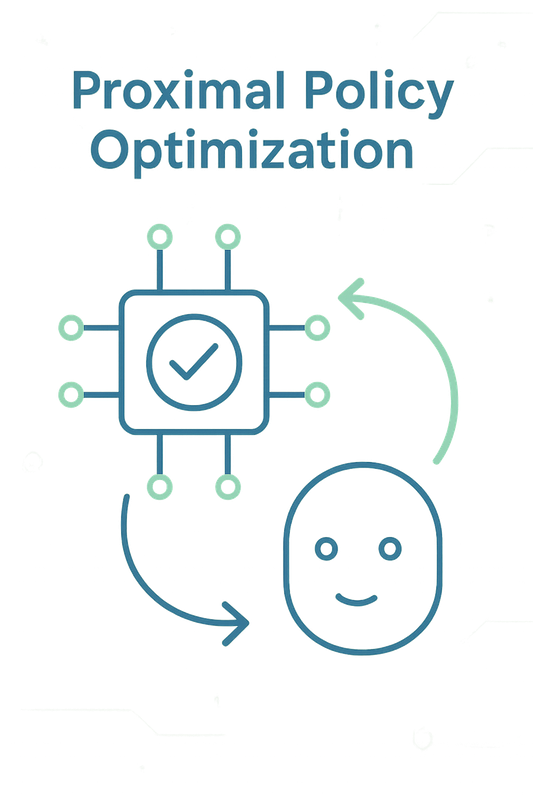
- Fine-tune Base Model: Apply RL (e.g., Proximal Policy Optimization) using the RM to optimize for helpfulness, safety, etc.
Treat the Reward Model like your UX metric engine. You’re aligning model behavior with user delight-not just math.
4. Building the RLHF Stack with Vertex AI
While RLHF isn’t natively abstracted in Vertex AI yet, the platform provides all the building blocks to implement it:
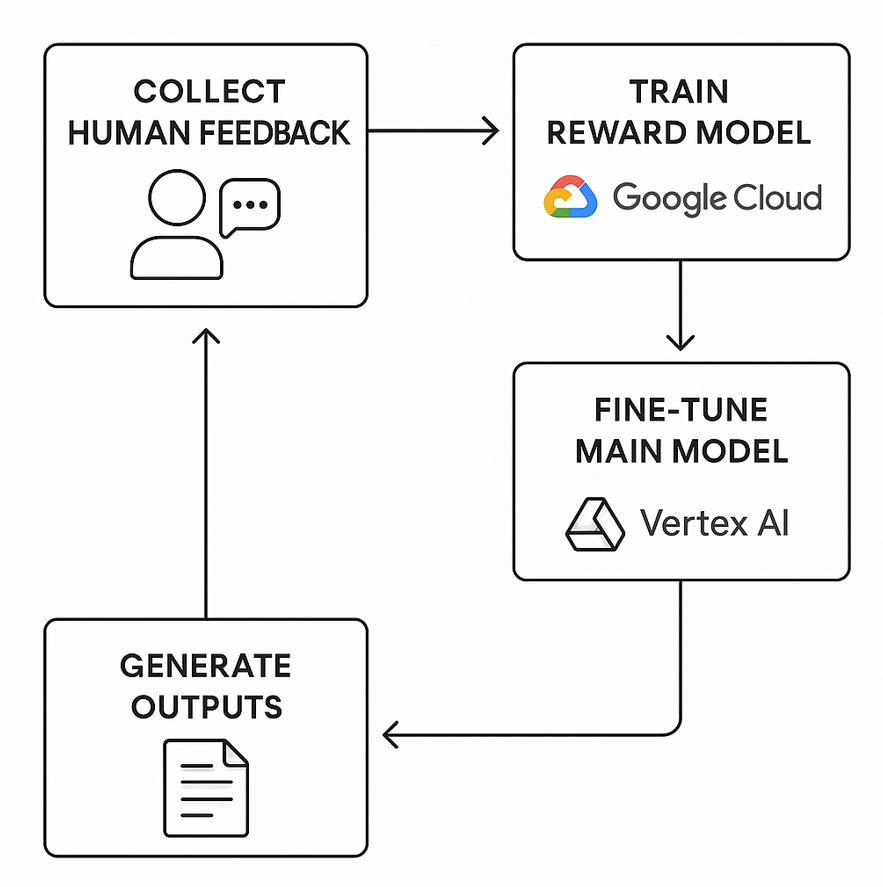
Feedback Collection
- Use Vertex AI Data Labeling or Ground Truth labeling jobs.
- Automate UI-based human ranking tasks via Workbench Notebooks.
Reward Model Training
- Train reward models using Vertex AI Custom Jobs with PyTorch or JAX.
- Save checkpoints and deploy using Vertex AI Model Registry.
Policy Optimization
- Leverage Vertex Pipelines to orchestrate PPO or other RL algorithms.
- Store metadata, artifacts, and evaluation results using ML Metadata Tracking.
Monitoring & Re-evaluation
- Track real-world behavior with Vertex Model Monitoring.
- Detect serving drift and retrigger tuning via pipeline events
5. RLHF Model Tuning Strategy: From Feedback to Production
| Phase | Goal | Vertex AI Tooling |
|---|---|---|
| Base Model Pre-training | Learn general task distribution | AutoML, Vertex Training Jobs |
| Reward Model Training | Learn human preferences | Custom Training, Model Registry |
| RL Optimization (e.g. PPO) | Align model to feedback signals | Vertex Pipelines, Workbench, OSS RL libs |
| Continuous Evaluation | Monitor behavior & alignment | Model Monitoring, Explainable AI |
Tip: Create separate pipelines for RM tuning and policy tuning to decouple testing and iterations.
Use Case for PMs: Smart QA in Manufacturing
In a smart manufacturing line, cameras use AI to detect micro-defects. Early models had high recall but were over-triggering stoppages for minor issues.
Engineers provided binary feedback (“Acceptable” vs. “Defect”) on edge cases.
Reward model trained using this annotated data.
Main model was fine-tuned via RLHF using PPO inside Vertex Pipelines.
Model retraining was automated with feedback loops.
Results:
- 41% reduction in false positives
- ⏱ QA downtime cut by 20%
- Improved collaboration between line workers and ML ops teams
Open-Source Alternatives for Early-Stage Product Teams
| Vertex AI Capability | OSS Alternative |
| Data Labeling | Label Studio, Prodigy |
| Custom Training | HuggingFace Transformers + TRL |
| RL Algorithms | PPO (via RLlib, Stable-Baselines3, Acme) |
| Serving & Monitoring | MLflow, FastAPI, Prometheus |
| CI/CD | GitHub Actions + KServe + Argo Workflows |
Final Word: Product Managers Shape Model Behavior
Reinforcement Learning from Human Feedback isn’t just an ML technique. It’s a product strategy - a way to align AI with real human needs.
With Vertex AI, product teams can:
- Orchestrate feedback pipelines
- Train preference-aligned reward models
- Optimize model behavior for trust, not just precision
And most importantly: keep humans in the loop as stewards of AI quality.
Let’s Discuss:
Are you using RLHF or planning to? What tooling or feedback design has worked for you?
Drop your experience or tag a fellow AI PM diving into model alignment.